FloAI
What does AgencyFlo's floai do?
Why your agency needs floai. Generates documents. Drafts invoices. Spots margin risks.
Generates documents. Drafts invoices. Spots margin risks.
The connective tissue between your operational layer and your intelligence layer. It turns the data you already have into drafted documents, tasks, follow-ups and margin alerts.

Connected to the whole loop
Nothing here is a silo. Changes flow to projects, invoices and your P&L automatically, so the rest of the system stays in sync without manual re-entry.

No stitched-together stack
Replace the patchwork of single-purpose tools with one operating system, so your team spends time on client work instead of moving data between apps.
Why a bolted-on AI assistant falls short
Most agency tools have added a chat box that can summarise a page or rewrite a paragraph. It sits to one side of the work and knows nothing about your clients, your rates or the project that's running late. So every task starts with a brief: paste the scope, paste the history, explain the pricing. FloAI is built into the operating system instead, so it already sees the live agency graph. The drafts it produces reference real engagements rather than placeholder copy you have to correct.
Work that writes itself back into the system
A generic assistant hands you text to copy somewhere else. FloAI writes back into AgencyFlo: a proposal drafts onto the client record, an invoice drafts from logged time, a task lands on the right project. There's no paste step and no second window to manage. The output is an updated record, not a message you still have to file.
Margin risk caught before close-out
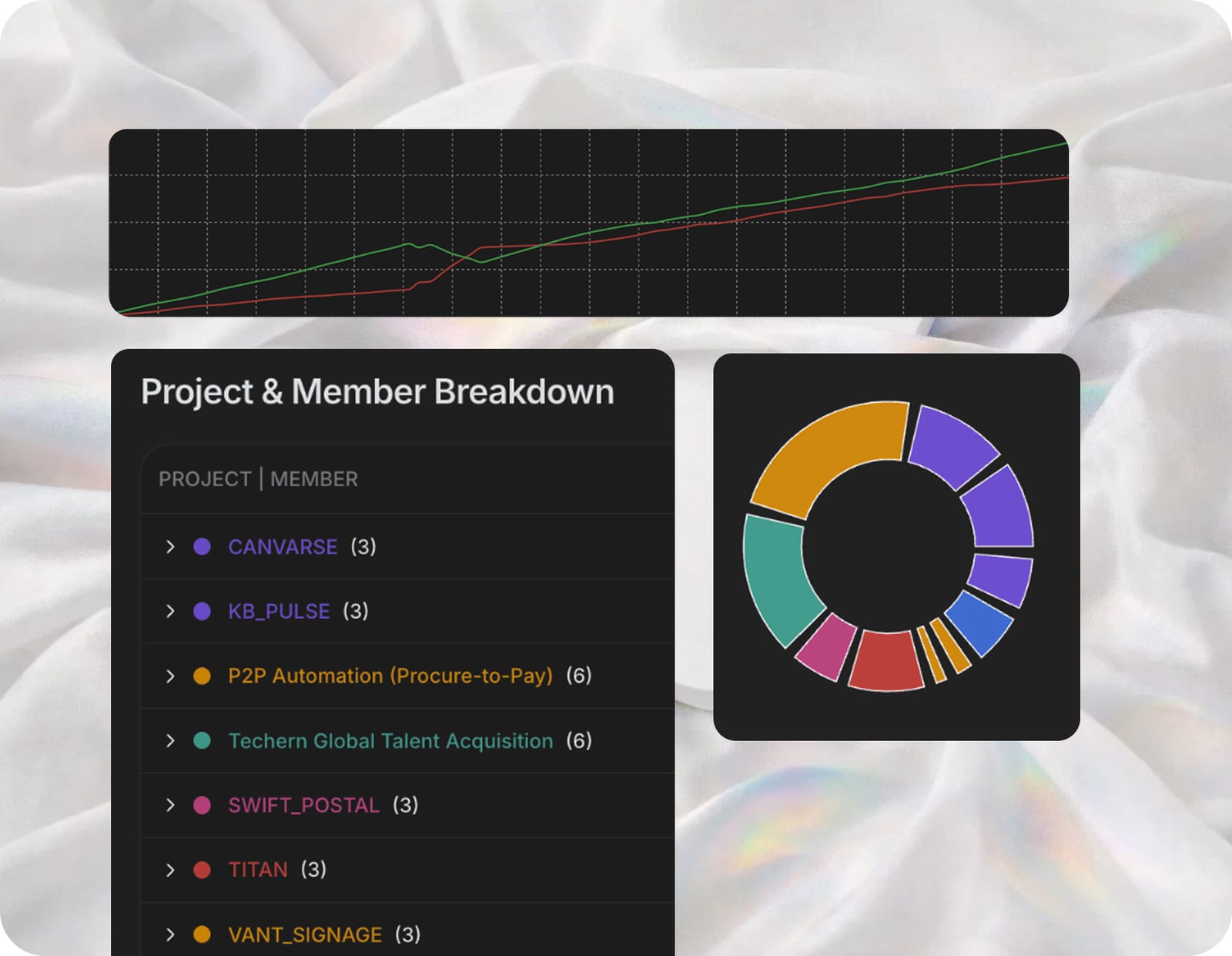
Because FloAI can see logged time against budget and the rates on each engagement, it flags projects where margin is slipping while you can still act. It surfaces scope creep, retainers running over and the jobs where the effective rate has dropped below cost. A generic assistant can't see any of that, because it can't see the work. That early warning is the difference between fixing a project and writing it off.
Frequently asked questions
What is FloAI?+
FloAI is the connective tissue between your operational layer and your intelligence layer. It reads the live agency data already in AgencyFlo (projects, time, rates, clients, calls) and turns it into drafted proposals, contracts, invoices, tasks and follow-ups, plus margin-risk flags on running work. Because it sits inside the system rather than in a separate chat window, everything it produces lands on the right record, grounded in what is actually happening.
Does FloAI replace ChatGPT for agency work?+
FloAI replaces ChatGPT for the agency-specific drafting work that would otherwise involve copying client names, rates and scope into a separate chat. The output lands directly on the right project, proposal or invoice in AgencyFlo, with no paste step. General research, writing and ideation still happen wherever the team prefers; FloAI is for the operations layer.
How is FloAI different from a generic AI assistant?+
FloAI runs on the live agency graph in AgencyFlo (projects, time entries, rates, clients, contracts) so the drafts it produces are grounded in what's actually happening in the studio. A generic assistant has to be re-briefed each time and can't see margin, utilisation or pipeline. FloAI also writes back into the system, creating tasks and updating records, not just text.
Can FloAI spot projects that are losing money?+
Yes. FloAI watches the relationship between logged time, project budget and the rates on the engagement, and surfaces projects where margin is eroding before the close-out. It flags scope creep, retainers running over, and engagements where the effective hourly rate has dropped below cost. Owners see the risk early, not at month-end when the project is already closed.
Do I need to train FloAI on my agency data?+
No separate training step. FloAI uses the data already in AgencyFlo (clients, projects, rates, past proposals, signed contracts, time entries) so it learns your studio's patterns as you work. The more proposals you send and projects you run, the more accurate the drafts and risk flags become. There's no model fine-tuning to manage.

Operate and grow your agency, the right way.
The only tool your agency needs to run faster with less and make more money.