Your unfair advantage in the AI era
AI-native by design, not bolted on top of a legacy stack.
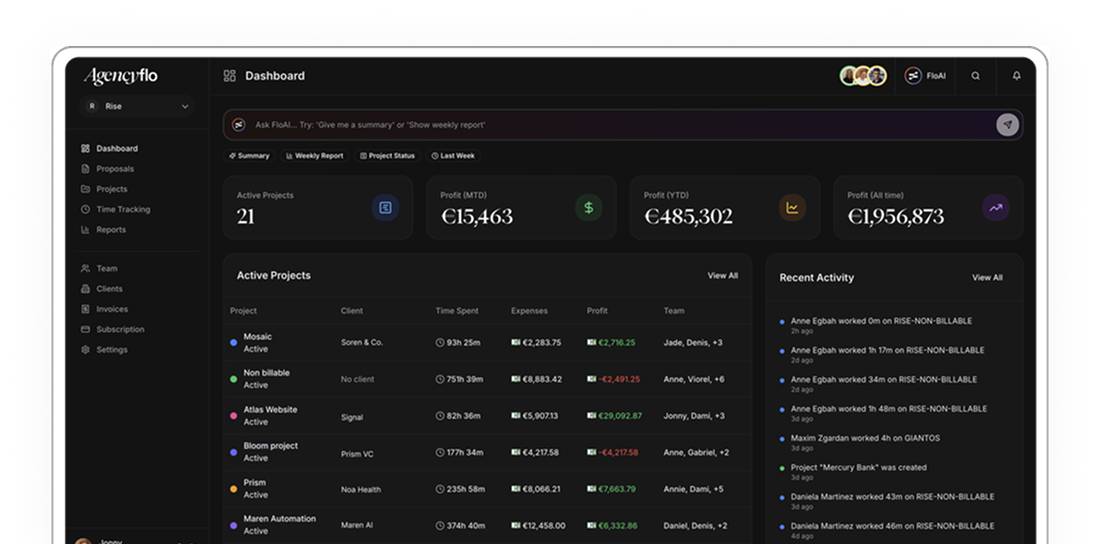
What gives an agency an unfair advantage?
Why AI-bolted-on can't reach AI-native
Every major SaaS product now ships a chat panel and calls itself AI-native. The data model underneath hasn't changed. A bolted-on AI can summarise the screen it sits on, but it can't answer a question that joins projects, time, scope and capacity, because that data lives in four tools. An AI-native operating system starts from the agency graph, not from the chat box.
The agency graph is the moat
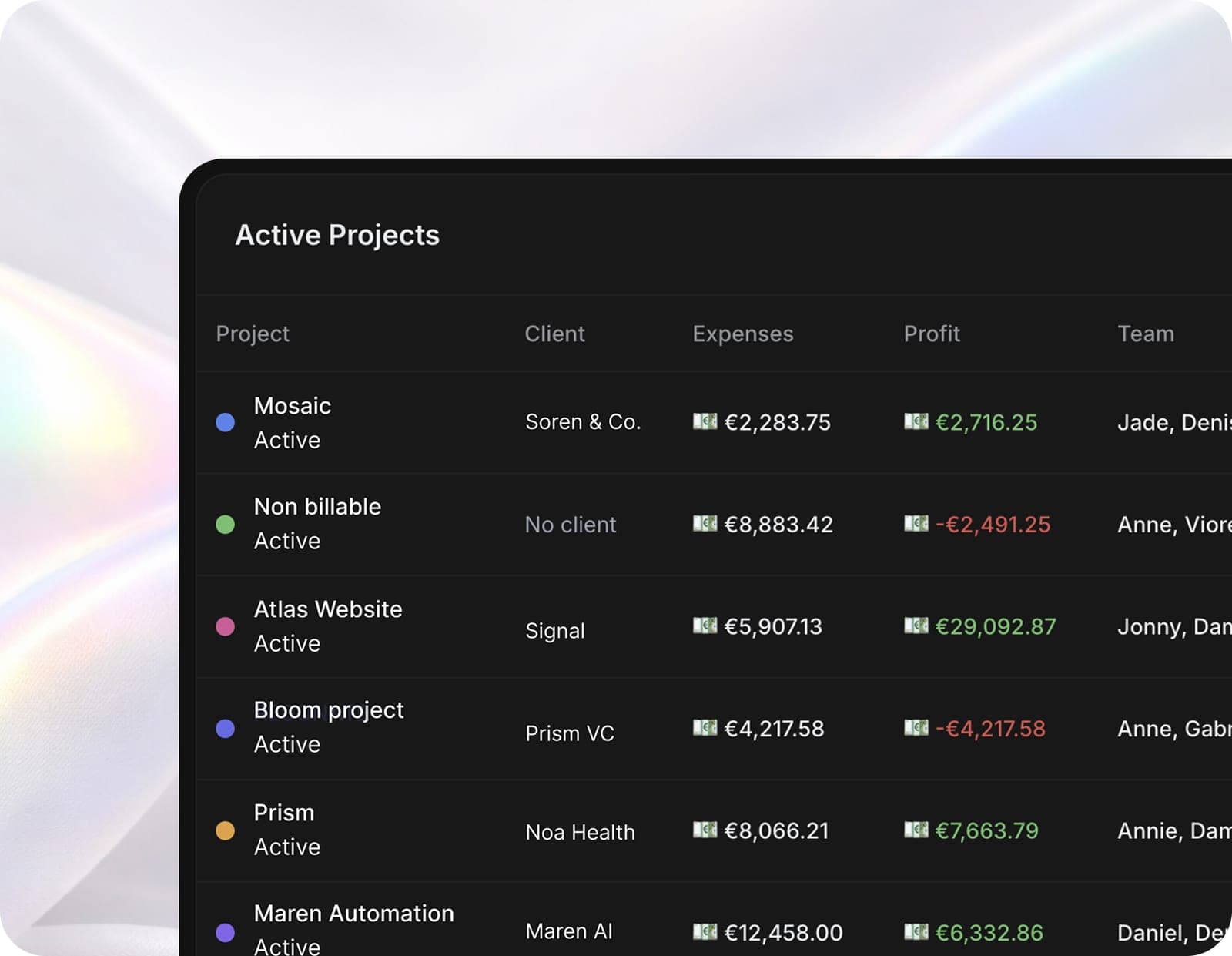
Profit per project, utilisation per person, scope creep on each retainer: every important agency metric is a join across multiple data sources. The platform that holds all of that in one model is the only one that can let AI catch margin leaks while they're still cheap to fix.
What changes day to day
Decisions that used to take a week of cross-tool reporting take a minute. The proposals that need a rate bump get flagged before they're sent. The retainer that quietly slipped to 12% margin gets caught in week one. The team spends time on the work, not on the spreadsheet that watches the work.
Why the gap widens
Every quarter a bolted-on stack stays bolted-on, the AI-native platform pulls further ahead, because each new piece of data feeds the same connected model. It's a flywheel, not a feature, and the agency that started a year earlier is a year ahead.
FAQ
What does AI-native actually mean?+
The platform's data model was built around the assumption that AI is part of how decisions get made, not a chat box bolted on a 10-year-old schema. It's the difference between AI that can answer a cross-system question in one shot and AI that can only summarise what's already on the screen.
Can my current stack become AI-native by adding AI features?+
Usually not in the strict sense. Adding AI features to a tool whose data model wasn't designed for it produces useful but bounded features (meeting summaries, smarter search, draft text). Reasoning across the whole agency graph requires a different architecture underneath.
Why does this matter for an agency specifically?+
Agencies live on margin per project and utilisation per person. Both metrics depend on data that sits in different tools (time, rates, costs, scope, capacity). In a bolted-on stack, no single tool sees them together, so the most important decisions get made late or on instinct. An AI-native platform holds the full graph in one place, which is the prerequisite for catching margin leaks while they're still cheap to fix.
What can an AI-native agency platform do that ChatGPT can't?+
It acts on your real data, not a pasted summary. FloAI reads the live agency graph (clients, rates, time, contracts) and writes back into it: drafting a proposal onto the right project, flagging a retainer slipping below cost, creating tasks from a call. A general assistant has to be re-briefed each time and can't see margin, utilisation or pipeline.
Isn't every tool adding AI now?+
Most are adding a chat panel over a data model that wasn't built for it, which yields useful but bounded features. Reasoning across projects, time, scope and capacity at once needs those things in one connected model: that's the difference between AI-native and AI-bolted-on.
How does this compound into an advantage?+
Every quarter on one connected model, more of the agency's history feeds the same graph, so the AI's answers get sharper and the cross-tool reporting it replaces stays expensive for competitors on a stitched stack. It's a flywheel: the agency that started a year earlier is a year ahead.
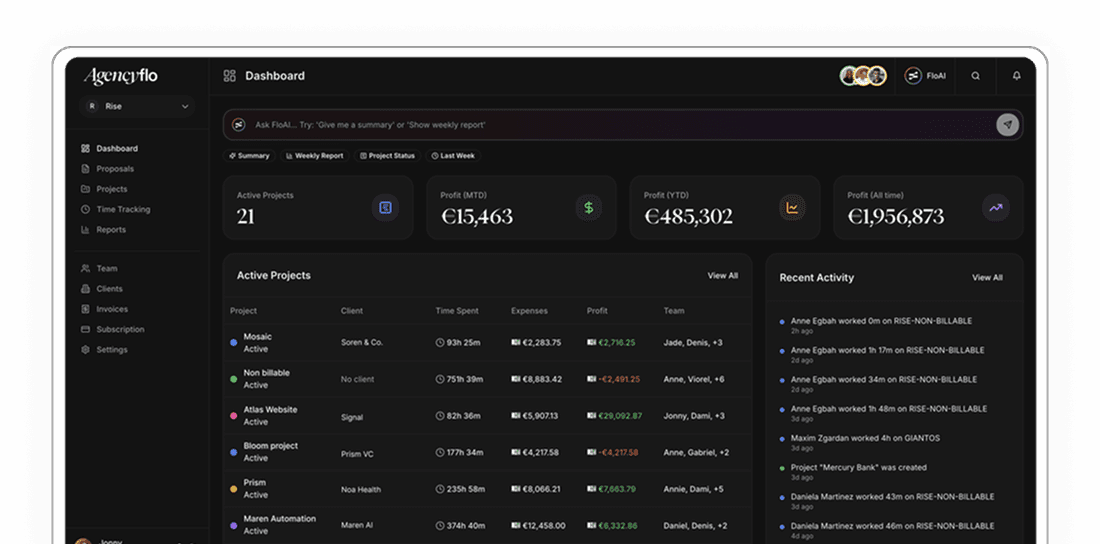

Operate and grow your agency, the right way.
The only tool your agency needs to run faster with less and make more money.